Theodore Roethke & the Birth of Cascadian Poetry (notes) for PAMLA
I am grateful for everyone who is in the room and interested in this topic. We think poetics are so important that we made the word our middle name when we changed the name of our organization to the Cascadia Poetics Lab in 2021.
These notes are taken from a panel talk I gave at the 10th Cascadia Poetry Festival last month, Cascadia as a Field of Action and from a talk I gave for the Friends of Roethke Foundation.
When you find your place where you are, practice begins, actualizing the fundamental point.
— Dōgen, Genjo Koan
Before Sam Hamill died, he told me that Theodore Roethke’s “North American Sequence” was the birth of Cascadian poetry. Sam Hamill was a poet, editor, translator and co-founder of Copper Canyon Press in Port Townsend, and was mentored and inspired by Kenneth Rexroth, so he had some sense of the history of the bioregion.
Cascadia (https://cascadia-institute.org/images/Cascadia-Map-big.png) (IMAGE 1).
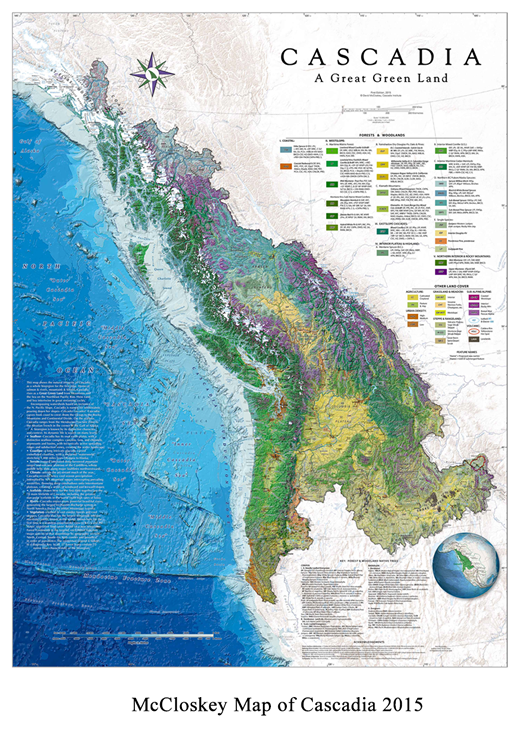
Cascadia is a bioregion that extends from Cape Mendocino, California, where — just off-shore — the Cascadia Subduction Zone begins at the Mendocino Fracture Zone. The bioregion extends north to the Aleutian Trench, which is at Yakutat, Alaska, and the eastern bioregional boundary is the Continental Divide. The Snake River watershed can clearly be seen as the southeast reach of Cascadia. These demarcations were set by the late David McCloskey of the Cascadia Institute, who created these very evocative maps. At a post-empire, late stage capitalism, peak-oil dharma position, these demarcations seem more important now than they’ve ever been.
The early bioregionalists believed that we live on this continent like invaders and that boundaries should be created, in Kirkpatrick Sale’s words, “by nature and not legislatures.” Roethke died before the bioregional movement started, but had animist notions — as described by Bill Barillas — with the belief that, “all of nature is conscious and endowed with spirit or soul, particularly plants and animals…” Of course there are parallels with Buddhism and indigenous wisdom in that notion, two traditions which in their own way resonate with and predate notions of bioregionalism. So, Roethke as “proto-bioregionalist.” We’re claiming him now!
Before Roethke
There were some stirrings of a poetry culture in Cascadia before Roethke’s time here, which started in 1947. During WWII, there were a group of Conscientious Objectors who were sent to Camp #56 on the Oregon Coast, near Waldport. (The camp is still there. Camp Angel.) Poets of note there were William Everson and Glen Coffield, who very much looked the part of the proto-hippie: (IMAGE 2).
The poets there produced the Untide Magazine. Many of the poets and writers at Camp Angel formed the nucleus of the San Francisco literary renaissance, a literary movement of significance, but south of Cascadia proper. The letterhead printing practice of the poets at Camp Angel continued in Santa Cruz and elsewhere in Northern California.
In the foreword (to The Horned Moon, 1944, by Coffield) there are these words:
Art is a device for finding life-perspective, a lens that brings to focus the human consciousness, on vital aspects of life. It may treat historically of the past, categorically of the present, or creatively of the future. Unfortunately the mind cannot be conscious of all objects and situations at once. But art is a crystallizing principle for determining which objects and situations are worth being concerned about, whether in the present age, or in the future, or in all time…
G. C.
January, 1944
Waldport, Oregon
For those interested in this story there is the fine book by Steve McQuiddy Here on the Edge (IMAGE 3).
Reed College
In 1947, a student with Seattle ties started attending Reed College in Portland. Gary Snyder would become friends with two other poets there, Philip Whalen of The Dalles and Lew Welch. Snyder was connected to bioregionalism from its earliest moments with Peter Berg and The Diggers in San Francisco and Snyder is the quintessential bioregional poet. He described bioregionalism as “stay put, watch what happens” and that is what he did at Kitkitdizze, near Nevada City, California, in the Sierra. No other poet comes close to Snyder in describing what bioregionalism is and in living and writing from that stance. His own serial poem “Mountains and Rivers Without End” owes a great deal of its philosophy to the founder of Soto Zen, Eihei Dōgen, whose most famous fascicle, Genjokoan notes: “When you find the place where you are, practice begins, actualizing the fundamental point.” This statement guided Snyder and the world would be a better place if we all took on this as a mantra. (5 min.)
Japanese-American Concentration Camp Literature
Based on scholarship that began in Japan, of poetry by incarcerated Japanese-American citizens during WWII, a book co-edited by Frank Abe documents the historical record of the The Literature of Japanese American Incarceration. (IMAGE 4). There were also short-lived haiku groups in Yakima, Portland and Seattle and a good deal of writing from the USAmerican concentration camps of WWII.
(Read from Page 201, IMAGE 5.)
Frank Abe on The Literature of Japanese-American Incarceration
WCW at UW
In 1948 William Carlos Williams was invited by Theodore Roethke to speak at the University of Washington. Williams delivered the lecture The Poem as a Field of Action. He was inspired to look to science to create a new measure for poetry besides the forms and meters imported from Europe. Two years later Charles Olson would publish Projective Verse, which was subtitled Composition by Field. (IMAGE 6). Let’s bookmark that notion of poem as “field.”
TISH, Vancouver, Vancouver Poetry Conference of 1963
TISH: a poetry newsletter, Vancouver was founded in August 1961 by young writers, George Bowering, Frank Davey, Jamie Reid, and Fred Wah, part of a larger group of University of British Columbia students who had been meeting over the past few years to discuss poetics with Warren Tallman and, that summer, with San Francisco Renaissance poet Robert Duncan. Among that larger group were future playwright Carol Bolt, critic Pauline Butling, short-fiction writer Gladys Hindmarch, film-maker Sam Perry, and poets Daphne Marlatt, Lionel Kearns, Maxine Gadd, Judith Copithorne, Robert Hogg, and David Bromige. https://thecanadianencyclopedia.ca/en/article/tish
(IMAGE 9).
The 1963 Vancouver Poetry Conference was the coming out party for this group and very much in the Pound/Williams strain of North American poetry. TISH is the most legendary and accomplished poetry movement in Canadian history. (BC poetry, my friend Scott Lawrence would remind me.) Bowering and Wah went on to be Parliamentary Poets Laureate, and their work has been the subject of much research. The Conference was the subject of The Line has Shattered, a film by Robert McTavish: https://vimeo.com/1134988420 (IMAGE 10). I have done MANY interviews with people mentioned during this talk. See CascadiaPoeticsLab.org and PaulENelson.com
https://paulenelson.com/2014/01/29/daphne-marlatt-interview-liquidities/
https://paulenelson.com/2015/10/21/george-bowering-nellie-grey/
https://cascadiapoeticslab.org/2022/01/fred-wah-interview-the-simple-mht/
Sister Mary (IMAGE 11).
Mary Norbert Körte was a poet and Dominican Nun who attended the 1965 Berkeley Poetry Conference in her religious habit. She engaged Jack Spicer on that occasion and later quit the church, became caretaker of a former Redwood logging camp where she wrote poems, taught in schools and was a redwood preservation activist in Willits, California, about as far south in the bioregion that you can go. This is of course after Roethke and there is a good literary community there in Mendocino.
Interview with Beat Nun Mary Norbert Körte
Finally, Roethke (IMAGE 12)
Roethke’s time in Cascadia started in 1947 and it was not long before he hosted William Carlos Williams, as noted above. The influence of Williams on Roethke and Cascadian poetry is palpable, in Seattle, Portland, Vancouver and in Northern B.C. at least.
Charles Olson, Robert Duncan, Robert Creeley, Denise Levertov and Allen Ginsberg were among the poets on the faculty of the Vancouver Poetry Conference in 1963, so very much out of the Pound/Williams New American Poetry, an anthology, published in 1959, that separated the raw, open form New American Poetry, from the cooked, inherited form poets of New Poets of England and America. & Robin Blaser was soon to relocate to Vancouver, by 1965.
& today there are thriving literary scenes in Seattle, Vancouver, Portland, Spokane, Kelowna, BC, Port Townsend, Vancouver Island, Eureka/Arcata and remnants of past glories in places like Prince George, BC and Walla Walla. Poetry is a part of the subculture in this bioregion. Roethke was creating a culture with his demanding teaching, his own practice as example and by the large number of poets who made their own contributions to bioregional literary culture.
But to go back to the years, 1957 to 1963, when the poems of The Far Field were being composed (Roethke’s last book published posthumously) (IMAGE 13).
In “The Abyss,” Roethke says, “Be with me, Whitman, maker of catalogues: / For the world invades me again.” In a culture that works hard to develop and reinforce individuality, the delusion of the individual actor, a very powerful and destructive delusion, Roethke was doing all he could to sing of the place he found himself in, with the mountains, glaciers, islands, fjords and other somewhat ineffable natural splendor. For a man with bi-polar disorder, doing all he could to hang on to a self, the prospect of merging it with the mind of place must have been terrifying on some level, yet that’s where he went. In part he found it in the San Juans and in part in B.C.
It was summer of 1957 that the incubation of the North American Sequence would begin, when Roethke visited Orcas Island and Oyster River on Vancouver Island, BC. And later to San Juan Island in summer of 1961. “In the long journey out of the self” is how the poem “Journey to the Interior” begins and out of the self is the mind of place. Non-local mind. Mind as verb. Participation in a system larger than local mind in which all other living things act. From “Meditation at Oyster River”:
III
In this hour,
In this first heaven of knowing,
The flesh takes on the pure poise of the spirit,
Acquires, for a time, the sandpiper’s insouciance,
The hummingbird’s surety, the kingfisher’s cunning…
It’s pretty remarkable (maybe audacious too) to pin-point a spot where a bioregional poetry began but it might be there on Vancouver Island at Oyster River. There are worse places, no doubt. I’d love to see that spot made as mythic as Wilson’s Bowl — off Salt Spring Island — which has become an unofficial poetry memorial, in some poetry circles, thanks to B.C. poet Phyllis Webb.
Having a legacy of students like Tess Gallagher, Richard Hugo, Carolyne Kizer, David Wagoner and lesser known poets like Harold Enrico, Henry Carlile and Eugene Marckx, shows that there was a beachhead established in Seattle, by Roethke, earlier than in any spot in the bioregion, a legacy that continues to this day.
From the poem “The Far Field”:
THE FAR FIELD
II
…
—Or to lie naked in sand,
In the silted shallows of a slow river,
Fingering a shell,
Thinking:
Once I was something like this, mindless,
Or perhaps with another mind, less peculiar;
Or to sink down to the hips in a mossy quagmire;
Or, with skinny knees, to sit astride a wet log,
Believing:
I'll return again,
As a snake or a raucous bird,
Or, with luck, as a lion…
I hope the work of the Cascadia Poetics Lab can be seen as attempting to extend this lineage into a sustainable future. I believe that the old bioregionalists had it right when they said we live on this land like invaders, we need to become reinhabitarians, we need to stay put and watch what happens and connect with the mind of place. For the best of them, as with traditional Indigenous people, place is alive and has a mind that we can become a part of, but it takes humility, ego surrender and an understanding that humans are part of — not the gods — of any place. Serial form, a poem including history, as Joanne Kyger said: “knowing the history of your place is a political act,” is also essential in my view. This is why my first book was “A Time Before Slaughter” and why I investigated the history of Auburn, WA, formerly known as “Slaughter.” 13 Minutes
Robert Bringhurst
I will end with earliest poetry that we can say was grounded in the Cascadia bioregion and that would be the old Haida poets Skaay and Ghandl, among others. (Image 14, Ghandl and & Story as Sharp as a Knife & Cascadian Zen.) Robert Bringhurst who has learned indigenous languages, helped create the font for indigenous languages that was used in Cascadian Zen Volumes I & II.
Bringhurst gave a talk in Cumberland, BC, August 2025, on a poet/shaman from the Eel River. In about 1906 a linguist named Pliny Goddard found a Kato speaker, Bill Ray, (phonetic: Tone I Quatch Sheelish) in the S.W. corner of Cascadia, speaking an Athabaskan language. I’ll let Bringhurst take it Bill Ray’s creation story myth from here: