While the poetics of the Cascadia Poetics Lab have not been systematized, one can get the gist of it with the following essays. This page is a work in progress. There has long been a tradition of “received” poetry in English (& other languages) but critical to our poetics is the notion of: “getting rid of the lyrical interference of the individual as ego” as Charles Olson noted in Projective Verse. That Olson a few lines later in the essay alludes to humility is critical. Umeek, E. Richard Atleo of the Nuu-chah-nulth Tribe also notes that humility is a necessary requirement in his people’s knowledge acquisition method known as Oosumich. CPL poetics values writing as vision quest and the Day Song exercise is one of the most effective approaches we have encountered to achieve that goal. Workshop participants may find it helpful to be familiar with these essays:
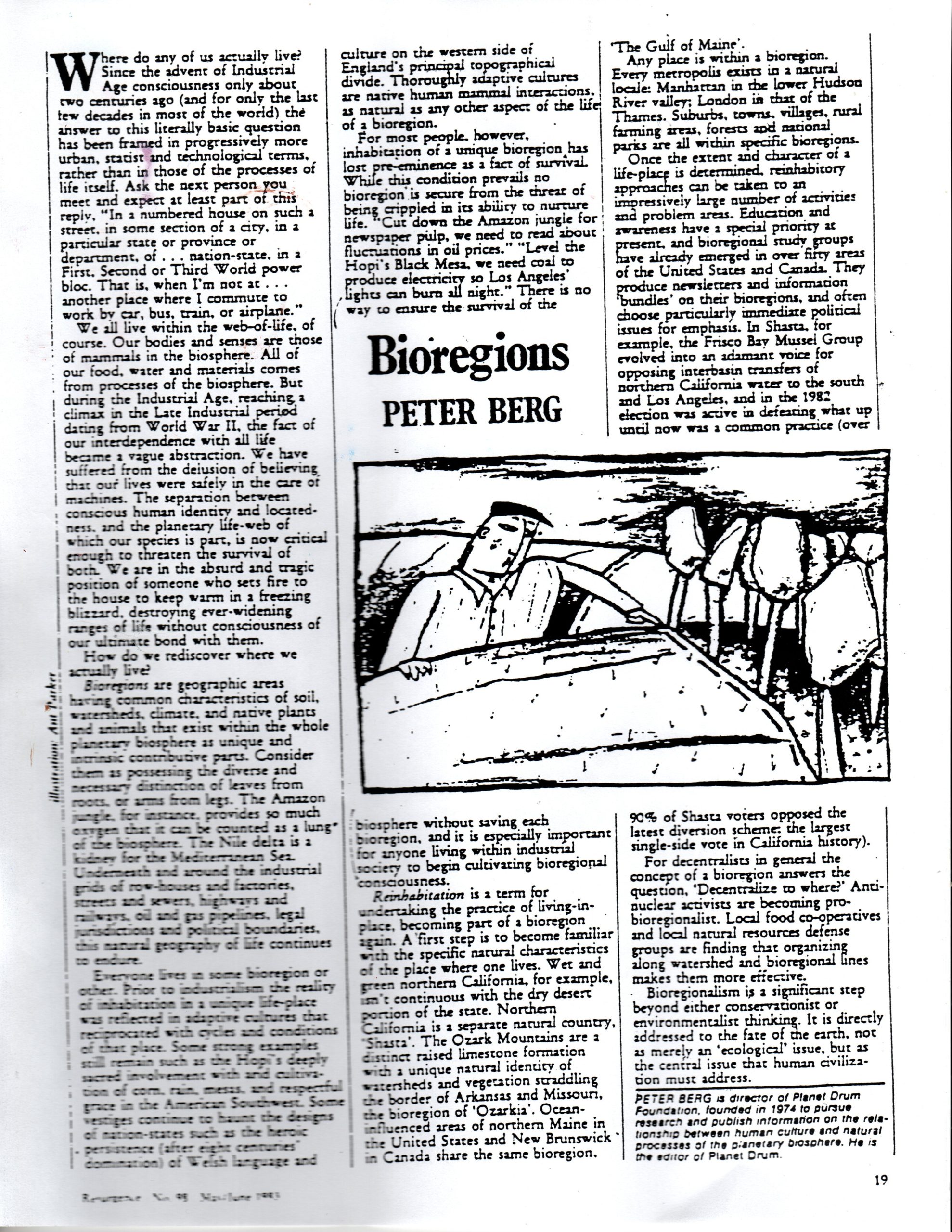
THE PRACTICE OF OUTSIDE by Robin Blaser. (Also see my piece: Some Notes on the Practice of Outside.)
Pound’s Melopoeia Becomes Phanopoeia by Giuseppe Schembri Bonaci (see: Beheading of Ignez.pdf) (Longer version.)
ON THELONIOUSISM by Wanda Coleman
Comfort Poetry vs. The Prophetic
The Prosody of Open Verse – Frank Davey and bp nichol
The One Mind – Larry Dossey
Intro to Bending the Bow – Robert Duncan
Poetry Before Language – Robert Duncan from the Journal of Biological Experience
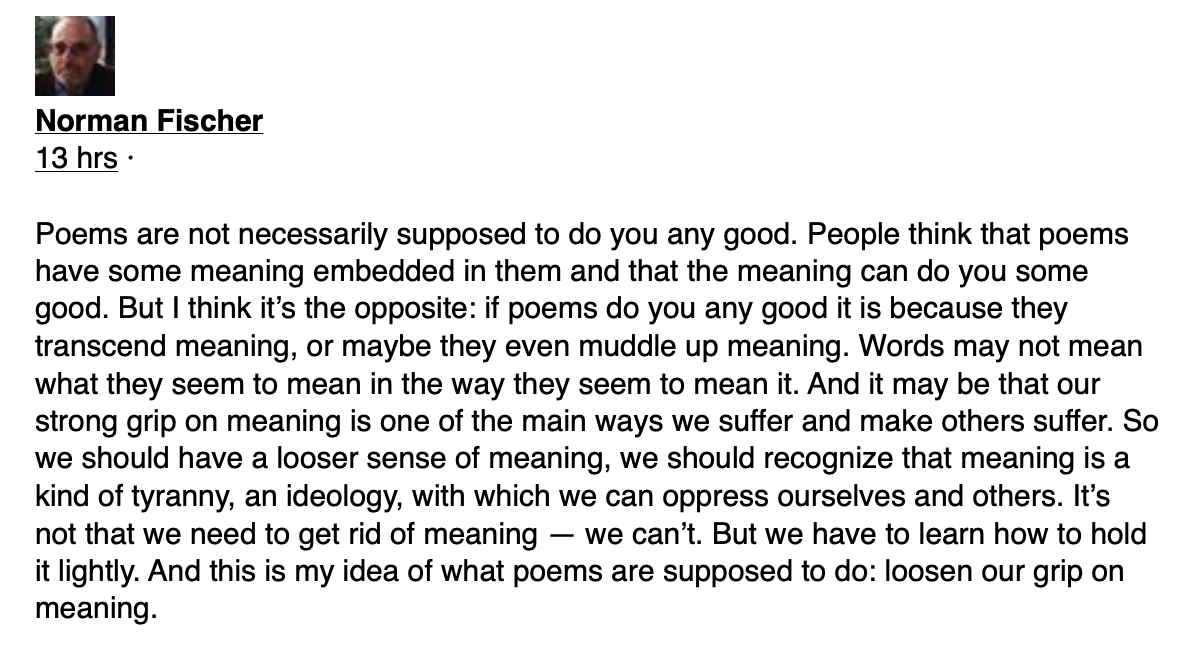
Norman Fischer on Meaning in Poetry (or lack thereof)
Mind Writing Slogans collected by Allen Ginsberg
Surprise Mind Allen Ginsberg
Epistolary Poetry – Sam Hamill
Reportorial Poetics – Brenda Hillman
EcoPoetics Minifesto- A Draft for Angie – Brenda Hillman
POSTMODERN AMERICAN POETRY – Paul Hoover
The Poet in Western Civilization – Kosho Itagaki
Ronald Johnson on Project Approach (from a 1985 talk in Madison, WI)
If you write poetry at all, do you think, God, I’m never going to write again, I’ve never got it right. But if you’ve got a project, and my theory is that you ask the universe a question, it’s going to answer you one way or another, no matter how you look at it, no matter where you go. It could be just looking at the sidewalk, or it could be looking at the town, or something, whatever Victorian poets did. But, I mean, if you God damn well ask it a question, it’s going to give you the answer.
Olson Now: Wales Black Mountain Conference – Pierre Joris
Jack Kerouac’s Alluvial Technique
Joanne Kyger and “the Kook Strain” in Olson: A Reading – Patrick James Dunagan
Olson’s teaching was far more concerned with demonstrating a manner of existing than any of the other more conventional modes of learning.
“practice as a mode of intellection, not simply a means of creating what the intellect explains.”
“the poet must have a cosmology” going on to insist “The universe is your collaborator […] You start with the active growth process going on in the cosmos. Cosmology is a cooperative act.”
Art as Morality Which Changes the Blood – D.H. Lawrence
SOME NOTES ON ORGANIC FORM – Denise Levertov
On the Function of the Line – Denise Levertov
Theory and Play of the Duende – Federico García Lorca
Daphne Marlatt Nov 1, 2024 CPF8 Workshop Handout
Introduction to SPLAY ANTHEM – Nate Mackey
Some Immediacies of Writing – Daphne Marlatt
Bernadette Mayer’s List of Journal Ideas
THE OBFUSCATED POEM – Bernadette Mayer
Dolphin Skull – Michael McClure
Personal Universe Deck – Michael McClure
Angels to Radios: On Rainer Maria Rilke – Ange Mlinko
Inside Dolphin Skull (McClure) – Paul E Nelson
Introduction to Organic Poetry – Paul E Nelson
Intro to McClure’s Specks – Paul E Nelson
Writing or ReWriting – Paul E Nelson
Introduction to Ted Berrigan The Sonnets by Alice Notley
PERSONISM: A Manifesto – Frank O’Hara
Charles Olson and the Nature of Destructive Humanism — Craig Stormont
PROJECTIVE VERSE – Charles Olson
SATURATION JOB – Charles Olson
HUMAN UNIVERSE – Charles Olson
Charles Olson and the Counterculture of the 1950s & 1960s – Craig Stormont
Open poetry is itself a way of responding to an open universe. That the universe is open is one of the “new recognitions involved in it. In such a universe — in the “field,” in the process–the self, only a thing among things, is a center of relationships. Its circumference is merely the space that bends around it and constitutes its particular field. Of most importance is the fact that the self is in the field (involved in an occasion, or an event), that the situation is ongoing, not to be described but presented or enacted. For the poet who, as Olson says, now ventures into the field has indeed put himself in the open, had given whatever mediates experience to confront experience directly–nakedly, freshly, firstly… – Sherman Paul
Apocalypticism Now? Chuck Pirtle
A FEW DONT’S BY AN IMAGISTE – Ezra Pound
Robert Duncan in Cascadia – Carlos Reyes
The Poet as a Creator of Social Values – Sonia Sanchez
Creativity and the Fully Developed Bard – Ed Sanders
Investigative Poetry – Ed Sanders
In Direct Contact with Rasa – Andrew Schelling
Post Coyote Poetry – Andrew Schelling
Fred Wah Nov 1, 2024 CPF8 Workshop Handout
CREATIVE WRITING LIFE tips – Anne Waldman
OPPOSITIONAL POETICS – Anne Waldman
INTRODUCTION TO THE WEDGE – William Carlos Williams
THE POEM AS A FIELD OF ACTION – WCW circa UW 1948
Beyond the attention economy, towards an ecology of attending.
A manifesto — Jason Wirth
Open Form – Heinrich Wölfflin