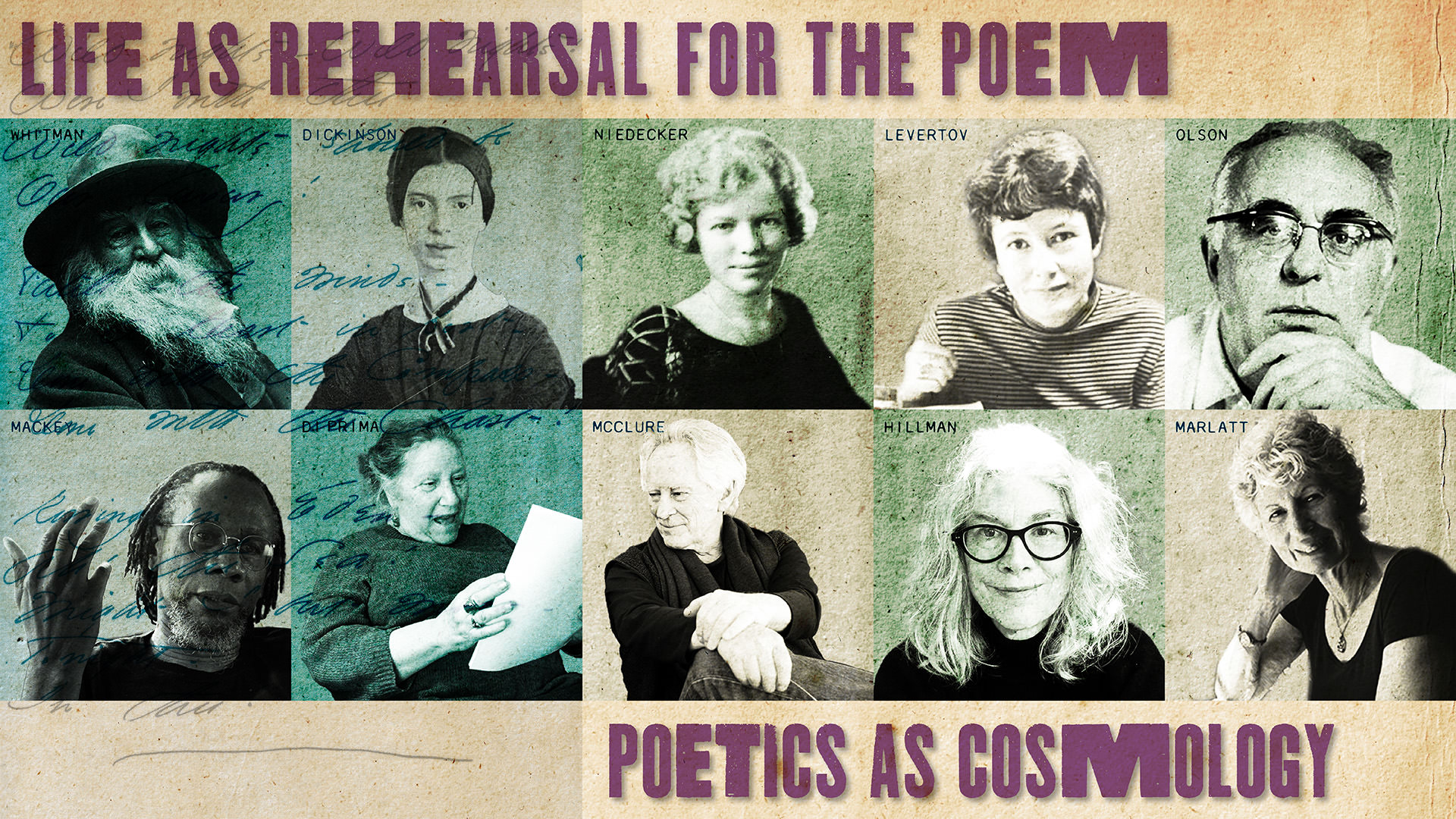
Portrait photo credits listed below
Life as Rehearsal for the Poem and Poetics as Cosmology 2025 Workshops
Life as Rehearsal for the Poem (LARFP)
- Sundays, 3-5 PM PDT
- November 2, 9, 16, 23, and 30, 2025
Poetics as Cosmology (PAC)
- Thursdays, 3-5 PM PDT
- October 30, November 6, 13, 20, and December 4, 2025
Life as Rehearsal for the Poem and Poetics as Cosmology 2025 Workshops
A five week online (Zoom) workshop best suited for continuing participants and more experienced poets (open to open form) in workshops facilitated by Cascadia Poetics Lab and Poetry Postcard Fest Co-Founder Paul E Nelson. Participate in reading and discussion of foundational essays, interviews, listening and other assignments, as well as spontaneous poetry composition exercises. In Fall 2025, we’ll explore a short history of Projective/Outside North America Poetry, focused on:
- Whitman and Dickinson
- WCW and Lorine Niedecker
- Olson and Levertov
- McClure and di Prima
- Daphne Marlatt, Brenda Hillman, and Nate Mackey
and related texts and assignments. How can one’s poetics be a cosmology and how can one maintain some experience of the Poetry Postcard Fest, & allow one’s life as a creative participant in the world to rise in one’s personal hierarchy of duties/activities? How is the projective poem an antidote to Silicon Valley attention fracking? An alternative to A.I. Slop? Will you let the machines do your thinking?
$250 for each five week session per person, scholarships are available. Canadians in need can pay $250 CAD.
Life as Rehearsal for the Poem (LARFP)
- Sundays, TIME, PACIFIC
- November 2, 9, 16, 23, and 30, 2025
Poetics as Cosmology (PAC)
- Thursdays, TIME, PACIFIC
- October 30, November 6, 13, 20, December 4 & December 11, 2025. Special guest Dec 11, all PAC and LARFP people are welcome.
Also, these essays on Poetics are helpful for beginning and advanced students.
Zoom link: (https:// us02web.zoom.us/j/ 2064225002)
Course Materials Week 1
(Thur, Oct 30, Sunday, Nov 2, 2025, 3-5 pm PDT)
READ: Walt Whitman I Sing the Body Electric
LISTEN: Allen Ginsberg on Walt Whitman (See transcript here.)
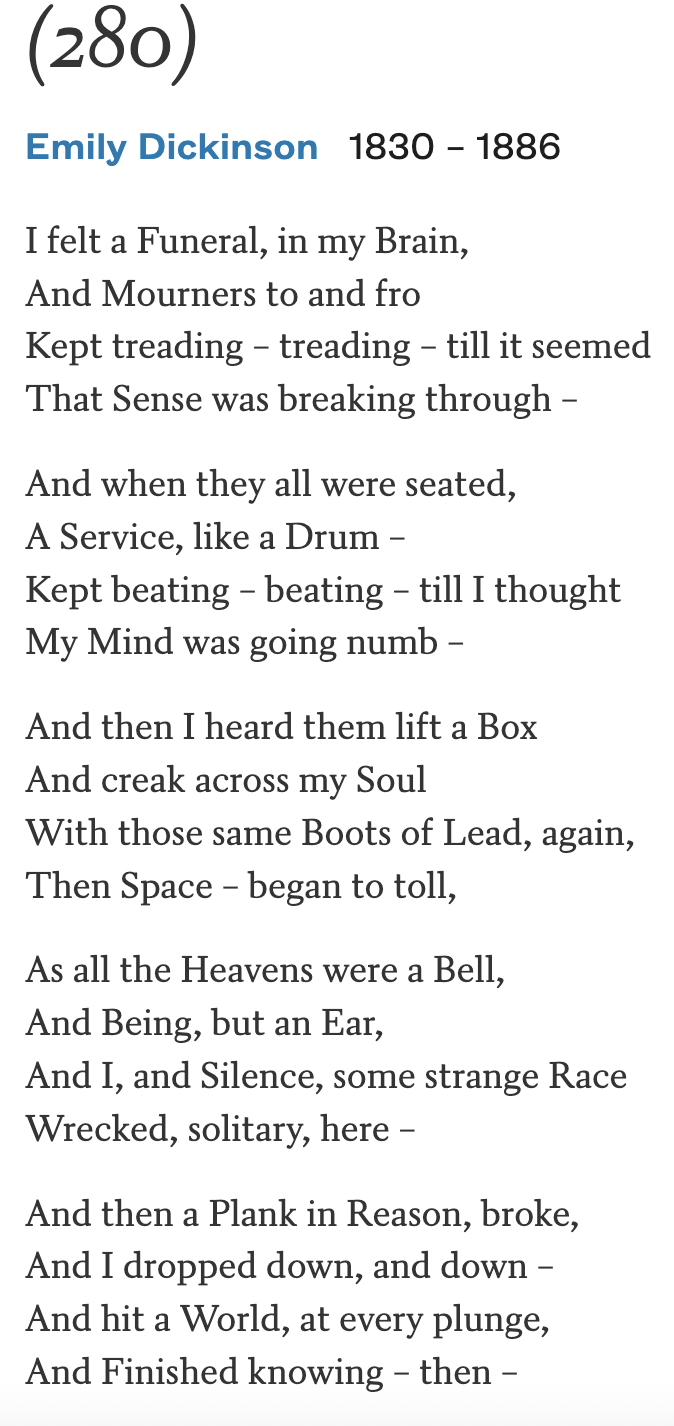
READ: ED poem
READ: Whitman – D.H. Lawrence
READ: Recreating Emily’s Garden
READ: Susan Howe – My Emily Dickinson
WRITE a poem in the style of Emily Dickinson about plants around your house. Try to avoid end-rhyme and go for the slant rhyme or assonance. Take a walk outside and each interesting looking plant or leaf that you see, take a photo, or take the actual leaf. Write about that leaf in the style of E.D., or about associations you have with that leaf, or something you’re dealing with at this time. Of course there is no “track” so feel free to follow the dictates of the moment. Quatrains are best. Even if you write ONE try to write in the wry style of Emily Dickinson.
Extra Credit: Walt Whitman Song of Myself More Extra Credit: Iggy Pop Reads Walt Whitman
WRITE: Song of Myself Grating. See the Mammal Grafting exercise here.
Take a stanza from Song of Myself, such as:
Course Materials Week 2
(Thursday Nov 6 & Sunday, Nov 9, 2025)
READ: R.I.P. Jack DeJohnette. Note his comments about improvisation, stress-testing form and the brain-healthy notion of open forms. LISTEN: The Amazing Adventures of Simon Simon
In Thursday’s class we talked about Jerome Rothenberg taking the nouns of Lorca and making poems called “The Lorca Variations.” Could you do that with Whitman’s nouns? Maybe some phrases from WW?
READ: William Carlos Williams – Asphodel, That Greeny Flower
WATCH/LISTEN: One of several shorts on Lorine Niedecker. There is also rare audio of HER reading and other LN offerings.
WATCH: WCW Film
WATCH: Nick Gulig on Lorine Niedecker
READ: Writing Out of Hell
READ: WCW Danse Russe
READ: LN Poems
READ: LN Brochure
WRITE: From the LN film short (My Life By Water) there is the line: “We live by the urgent wave of the verse.” Can you write something starting with that line about where you live in the short compressed lines of Niedecker? Can you baste it in the place where you live and its specific plants and animals? OR read LN’s Calendar poems and graft from one of them, or write a few like that: NEXT YEAR OR I FLY MY ROUNDS, TEMPESTUOUS
WRITE: A cover of WCW’s “In Chains.” (It was in the Writing Out of Hell essay.) Use the Cover Poem technique, or maybe write a response. How to balance rhetoric and poetry? How not to get carried away with loathing for any specific you know who? Remember, if done right, the poem will long outlast any fascist S.O.B.
Extra Credit: WCW – The Poem as a Field of Action and “Those to Whom Interesting Things Happen”:
William Carlos Williams, Kenneth Rexroth, Lew Welch, and Joanne Kyger, and the Genome of San Francisco
Renaissance Poetry. (Login and a bit of an effort required to read this one.)
Course Materials Week 3
(Thursday Nov 13 & Sunday, Nov 16, 2025)
READ: Charles Olson Saturation Job
READ: Some Notes on Organic Form – Denise Levertov
READ: On the Function of the Line – Denise Levertov
READ: The Mutes – Denise Levertov
READ: A Clearing – Denise Levertov
WATCH: Denise Levertov, from USA: Poetry NET Outtakes Series: March 20, 1966 —The Poetry Center
WRITE: A transportation poem in the style of Denise Levertov’s two poems in the video above. It could be a driving poem, or a public transportation poem. THERE ARE NO SUBWAYS IN NANAIMO or SANTA CRUZ! But you get the idea. “Don’t make a fuss, just get on the bus.” Maybe the public transportation poem could be like the Artist Date in The Artist’s Way. Make an afternoon of it. Maybe there is an errand you have to run. Take the bus, see what colorful characters you encounter. If you ever want to take the best people-watching bus in the world, come take the King County Metro 7 with me and you will not be disappointed. One could do a SERIAL POEM riding the 7 for a month.
READ: As The Dead Prey Upon Us – Charles Olson
or LISTEN: As The Dead Prey Upon Us – Charles Olson
(Maybe you can read the words while listening to the audio?)
WRITE: Could you get a dream poem like this poem? Maybe trying setting an intention before going to bed. You could use the COVER POEM technique to craft your poem.) If no dream recall, graft from any part of the poem. I am especially fond of this part of the poem that features the phrase “human possibilities.” Are you into dream interpretation? If yes, look up “cars.” If you are not familiar with the “grafting” technique, see MAMMAL GRAFTING.
READ: Charles Olson 1965 Reading at the Berkeley Poetry Conference (RFL!)
LISTEN: Charles Olson 1965 Reading at the Berkeley Poetry Conference (AUDIO) (RFL)
This course is based on the notion that the life we live is a rehearsal for the moment of poetry composition. Can we feel the magnetic feeling that Myles notes in that link? This course is based on the notion that we improvise every day and the poem can be closer to how we live life and not a construct of what others expect our poems or lives to be. Is there any SURPRISE MIND in your work? This is one of the biggest failings of the average poet in North America. Two Olson essays linked on the POETICS page are VERY HELPFUL for this course, PROJECTIVE VERSE and HUMAN UNIVERSE.
Course Materials Week 4
(Thursday Nov 20 & Sunday, Nov 23, 2025)

Michael McClure, Shepard Powell and Diane di Prima photographed by Amy Evans McClure
READ: Diane di Prima Loba Opening Poem or Whole Book
READ: Diane di Prima Occult Transmission or read about her Occult Library
READ/LISTEN: Diane di Prima Rant LISTEN or READ
LISTEN: If you have not heard it, my Nov ’99 interview is here.
READ: Diane di Prima Revolutionary Letters 1, 4, 12, 29, 36 & others
WRITE: Exercise: di Prima Tarot Meditation Poem. Taking a page out of Diane di Prima’s book, find a quiet space to quiet your mind, do a divination (Tarot, I Ching, Runes, bibliomancy or something else) one card, or one Rune, and if possible, carry that card or Rune with you for a day or two, walking in nature, thinking about it and writing down in a pocket journal information that comes to you regarding the divination. It might be important to note any animals you encounter, any associations you have about the card/rune and any revelations from (or about) your own personal mythology that come to you. Once you feel like you have sufficient energy/language/ideas about the divination, find your quiet writing space and write a poem. Maybe you get a hit immediately after drawing the card. You may want to write in your pocket journal in a tribute to di Prima’s hand-made books. Maybe decorate it too with drawings, stickers, ink stamps, collage &c. Go deep. There is no demand to write for anyone else or share your work. If you do not own divination materials, feel free to explore Facade.com
or WRITE: A Revolutionary Letter of your own. You could write a COVER POEM for any one of those, or all of them. You might find that you start with a cover poem but it veers off course, or finds its own course, which is a development worth following.
WATCH: McClure at the Zoo
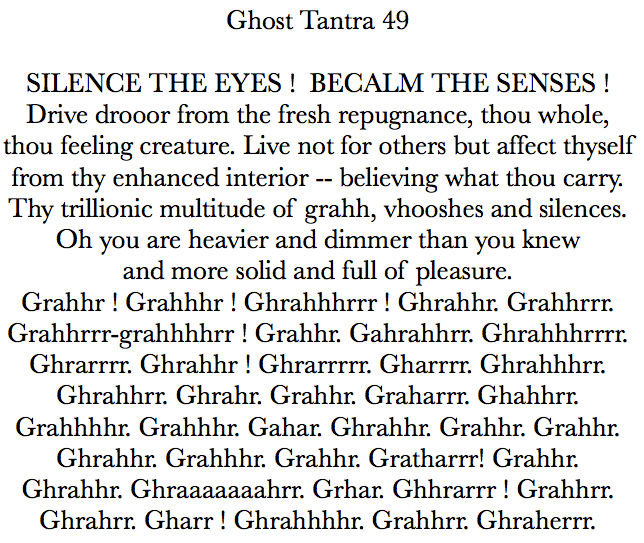
READ: Ghost Tantra 49
READ: Steven Fama’s 17 Reasons Why I Love the Work of Michael McClure
READ: Dharma Devotions: #41. #42. #75
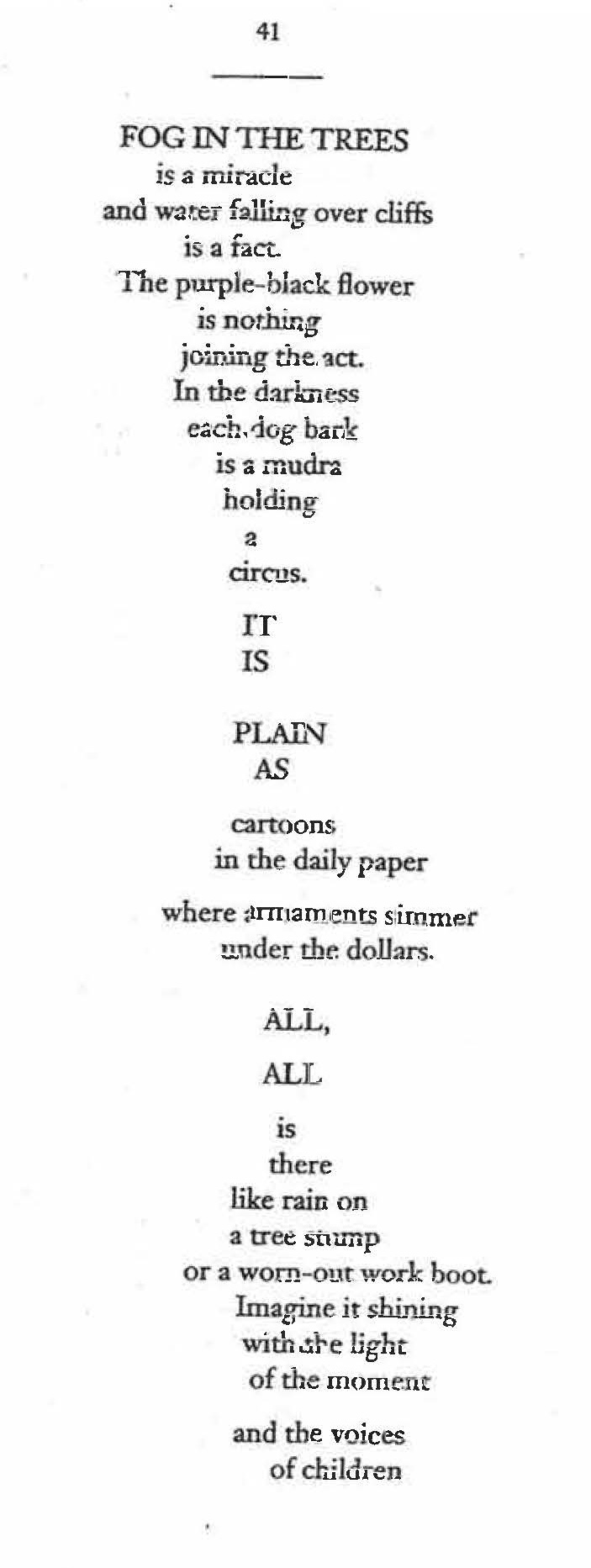

Exercise: Mammal Grafting McClure. Take a line from one of McClure’s Dharma Devotions, write (or type it) on a piece of paper or on your Mac and continue with your own sense impressions of the moment. Sometimes he lets the sound lead him on like “prizes” and “sunrise” in Dharma Devotion #75, or “fact” and “act” in #41. Could you write something from his notion in the 17 Reasons post on “Without proportion?”
My 1995 interview with Michael is here.
Course Materials Week 5
(Thursday DEC 4 & Sunday, Nov 30, 2025)
There is a lot of material here. You are not expected to read/listen/watch it all. You can skim, to see which parts resonate with you, or you can pick one of the three poets and engage all of their material, or do something else. In these five weeks (soon to be six) I’ve tried to give you some base at understanding all of these 11 poets and maybe steal part of their fire. I loved when some poets here were able to reference a note or two of their readings in the poems they wrote from an assignments. The highest compliment is to be of use. To be generative. With so much work there is bound to be some of it, which in the parlance of William Carlos Williams is: “Too little fecundate to impregnate your world.”
READ: Frida’s Dreams For Sale
1) NATE
LISTEN: Nate Mackey Interview segments (listen to as many as you see fit.)
READ: Some musings on interviewing Nate.
READ: Preface to Splay Anthem
READ: Nate Mackey on Seriality
READ: Song of the Andoumboulou: 21 LISTEN (There is a Soundcloud Recording embedded in the link to the poem) Mackey reading other poems is linked here.)
OPTIONAL LISTEN: Don Cherry Mu (Dissonant/Outside music)
2) BRENDA
LISTEN/WATCH: Brenda Hillman, Dec 2022 interview
LISTEN/WATCH: Brenda Hillman Dear Emerging, pre emerging & post emerging poets
READ: Brenda Hillman, EcoPoetics Minifesto: A Draft for Angie
READ: Brenda Hillman Food
WRITE: In the EcoPoetics Minifesto there is a section:
E–then a poem is its own action, performing practical miracles:
1. “the miracle of language roots” –to return with lexical adventures
2. “the miracle of perception” –to honor the senses
3. “the miracle of nameless feeling” –to reflect the weight of the
subjective, the contours of emotion
4. “the miracle of the social world” –to enter into collective bargaining
with the political & the social
Take a word from that section, or a word that interests you, look up the etymology and write a poem reporting on it and what associations, or sonic directions that news inspires in you. You could keep the Minifesto handy and state or allude to themes that Brenda invoked. Extra credit if you can write in the style of Mackey or Marlatt.
WRITE #2: Read the Brenda poem Food and then go to a fast food restaurant, or even your local co-op, order something to consume there, and take notes in your pocket journal for a poem. You could write a poem while there. Or maybe you can graft from the amazing line:
imagine all thistranslated by the cry of time moving through us
This line reminds me of Dōgen’s concept of Uji. Kosho Itagaki recently wrote an essay on Uji that you could read if so interested and write a poem melding Brenda’s irreverence with Dōgen’s notion of the Time Being.
3) DAPHNE
LISTEN: Daphne Marlatt 2014 Interview
READ: Daphne Marlatt, Imperial Cannery, 1913

WATCH: Daphne Marlatt, 4th Cascadia Poetry Festival, 2016, Subud House
WRITE: A ferry poem in the style of Daphne’s Air. Maybe you could use the form of Imperial Cannery, 1913, with left-hand justification for one stanza, moving to right-hand justification for the next. Does Imperial Cannery, 1913 remind you of Haibun? Maybe write a Ferry Haibun?
Course Materials Week 6
(Sunday, DEC 7, 2025 & Thursday DEC 11, 2025) Due to registration difficulties, we’ll offer a free-form Week 6 for this class and all workshop participants are welcome to join us at 3pm, December 11 for a session with special guest Brenda Hillman. Come with questions or poem requests for Brenda.
“There is a vitality, a life-force, an energy, a quickening, that is translated through you into action and because there is only one of you in all of time, this expression is unique. And if you block it, it will never exist through any other medium and be lost. The world will not have it. It is not your business to decide how good it is nor how valuable nor how it compares with other expressions. It is your business to keep it yours clearly and directly, to keep the channel open. You do not even have to believe in yourself or your work. You have to keep open and aware directly to the urges that motivate you. Keep the channel open.”
–Martha Graham, quoted in Dance to the Piper by Agnes de Mille
READ: Kosho Itagaki, The Poet in Western Civilization
LISTEN: Singing Bullets Season (Soundtrack)
READ: Andrew Schelling on Direct Contact with Rasa
READ: A 1970 Visit That Never Happened
CALL FOR POEMS: Solitary Plover (Deadline January 10)
OUR DAYSONG WORKSHOP WILL HAPPEN TWICE IN JANUARY.
Take your spontaneous writing practice to a new level by writing a daysong, February 1, 2026. Find some daysong resources here: https://paulenelson.com/daysong/
Our next round of LARFP and Poetics as Cosmology starts in March 2026.
Photo portrait credits:
- Lorine Niedecker: Lorine’s high school portrait. She graduated from Fort Atkinson High School in 1922. Photo courtesy of the Hoard Historical Museum and Fort Atkinson [Wisconsin] Historical Society.
- Charles Olson: John Olson photograph by Juangris
- Michael McClure: photograph by Gloria Graham during the taping of Add-Verse, 2004
- Diane di Prima: photograph by Gloria Graham during the taping of Add-Verse, 2004
- Nathanial Mackey: photographed by Gloria Graham during the taping of Add-Verse, 2005
As part of your registration, you become a member of Cascadia Poetics LAB. Membership is free, carries no cost or obligations, and is recorded with your registration. See our Membership Policy for details.